In one of our previous posts on inventory loss prevention, we looked at Damaged Goods Rate and Cycle Count Accuracy Rate as key metrics for protecting inventory investment. Both are shaped heavily by something that rarely makes it onto a loss prevention checklist: where products actually sit in the warehouse.
Slotting, the practice of assigning SKUs to specific storage locations based on velocity, weight, dimensions, and handling needs, is one of the most underused tools operations teams have. Get it right and you cut the handling events that cause damage, shorten the travel that drives labor cost, and improve pick accuracy simply by putting products where pickers naturally expect to find them.
Below is what effective slotting looks like in practice, how to measure whether it's working, and how to keep it from decaying six months after you've done the work.
The Hidden Cost of Ad Hoc Storage
Every time a picker walks to a location to retrieve an item, three things are at stake. The travel itself costs time, and that time scales with distance. The pick is a handling event, and a poorly designed location (bad height, awkward angle) raises the odds of damage. And if the wrong item is sitting in that slot, you get an accuracy error on top of everything else.
Most warehouses don't set out to slot badly. Products usually end up where they are because that's where space was open when a truck showed up, or because a receiving associate made a fast call under time pressure. Understandable, given how warehouses actually run day to day. But the result is a layout optimized for whatever was convenient last Tuesday, not for how the operation runs at scale.
That cost is real, and it's easy to miss because it doesn't show up as a line item. It's baked into aggregate labor hours, aggregate damage rates, aggregate accuracy numbers. When companies actually run a slotting analysis, it's common to find that somewhere around a fifth to a third of labor cost traces back to travel patterns that a reslotting project could largely eliminate.
The Principles of Effective Slotting
Velocity-Based Placement
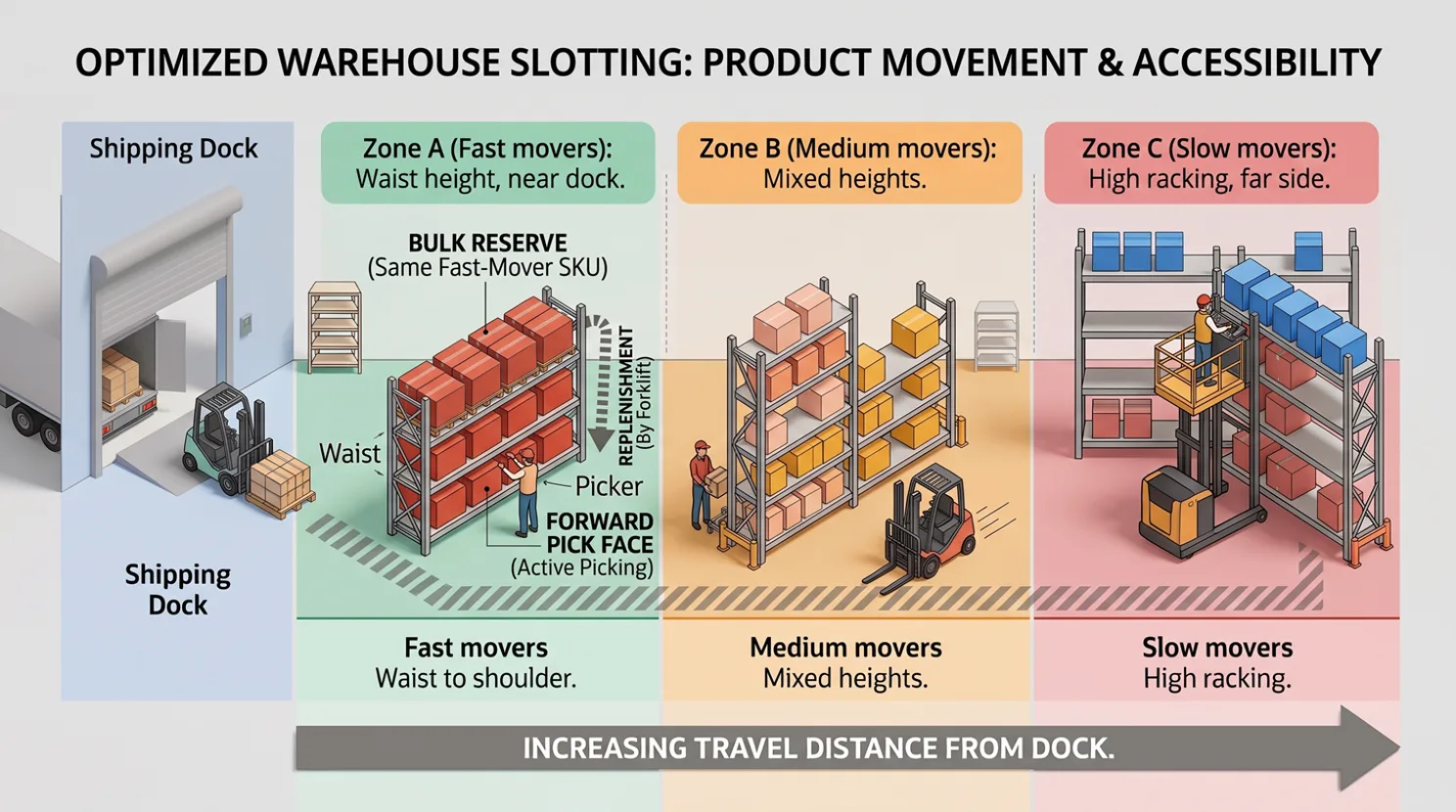
The basic rule: your fastest-moving SKUs (the "A" items, in ABC terms) go in the most accessible spots, and your slow movers (the "C" items) can live somewhere less convenient.
What counts as accessible varies by facility, but generally it means close to the dock or pack area, at a height between knee and shoulder, in an aisle wide enough to move through quickly. An item that gets picked 40 times a day has no business sitting in the back corner of the building, or requiring a step stool.
That doesn't mean the space above a fast mover's pick face goes unused. In most rack configurations, the accessible tier is just the forward pick face: a shallow position holding enough stock to cover picking between replenishment runs. Bulk reserve for that same SKU typically sits directly above it, at pallet height, and gets brought down by forklift as the pick face runs low. The picker never touches that upper tier; it exists purely to keep the accessible position stocked without a person having to retrieve pallet-sized quantities by hand.
Low-velocity items can absorb the inconvenience of high racking or a remote zone, because a picker only pays that cost occasionally rather than constantly.
Weight and Ergonomics
Physical characteristics matter almost as much as velocity for manual picking. Heavy cases belong at waist height or below, not because it's a nice-to-have but because repeated lifting from shoulder height is where injuries and fatigue accumulate. Lighter product can go higher without the same risk.
This shows up clearly in beverage warehousing. A case of glass bottles is meaningfully heavier than the equivalent case in cans or flexible packaging, and if you slot both at the same height regardless of weight, you're creating injury risk on one end and breakage risk on the other. Glass that gets dropped from shoulder height rarely survives the fall; the same case handled at waist level usually does.
Compatibility and Hazard Segregation
Slotting also has to account for what shouldn't sit next to what. In food and beverage, strong-odor products can't go near items that absorb odor. Temperature-sensitive SKUs need to stay in their zone. Chemicals and food products need to be kept apart under food safety rules, full stop.
There's a practical layer to this too, beyond the regulatory one. You don't want a fragile glass product parked next to a heavy, unstable pallet that could tip into it. And anything with a short remaining shelf life needs to sit in a forward, easy-access position so FEFO rotation actually happens instead of being aspirational.
Family Grouping and Zone Design
Slotting individual SKUs well matters, but how you group products across the warehouse determines whether multi-line orders are efficient. If the SKUs that tend to appear together on an order also sit together physically, a picker can knock out that order in one pass instead of crossing the building for every line.
This matters a lot for promotional bundles and seasonal multipacks; anything sold as a set benefits from being co-located so the pick path doesn't fight the order structure.
Measuring the Impact of Slotting
Reslotting isn't free. It costs labor to execute the moves, downtime while it happens, and planning time to design the new layout in the first place. So it's worth establishing a baseline before you touch anything and tracking the same metrics afterward to know whether it actually paid off.
A few worth tracking:
- Lines picked per labor hour. The cleanest read on pick efficiency. Operations that were previously unoptimized often see something in the 10–25% range of improvement here after a reslotting effort, though the actual number depends heavily on how bad the starting layout was.
- Travel distance per order. If your WMS logs travel paths, or you can observe it directly, this tells you plainly whether the new slot assignments are doing what you intended.
- Damaged goods rate by location. Break damage incidents down by slot and you'll often find a handful of locations driving a disproportionate share of the problem: usually a product sitting too high, too close to a busy aisle, or next to something it shouldn't be near.
- Pick accuracy rate by zone. Errors tend to cluster where similar-looking products sit next to each other. A zone-level breakdown surfaces design problems that an aggregate accuracy number would just hide.
- Cycle count discrepancy rate by location. Hard-to-reach locations tend to produce shortcuts during put-away and replenishment, and those shortcuts show up later as inventory record errors.
Building a Program That Doesn't Decay
The hard part of slotting isn't the initial optimization; it's keeping it good as SKU mix shifts, demand patterns change, and new products get introduced every month.
Do the work once and walk away, and it degrades. Within six to twelve months, velocity patterns have usually shifted enough that a meaningful chunk of your slot assignments are no longer right. Give it two or three years with no maintenance and you're often back close to where you started.
Set a review cadence. A quarterly review, using current velocity data, is a reasonable minimum for catching the highest-priority repositioning needs. Between those reviews, you still need a process for flagging new SKUs before they get parked in whatever spot happens to be open.
Write down criteria for new SKUs. One of the more useful process changes a team can make is having an actual protocol for where new products get slotted (based on forecast velocity, weight and dimensions, and handling needs) instead of defaulting to whatever's free. This is what keeps a slotting program from eroding one new-item decision at a time between the big reviews.
Actually use the data you're already collecting. Most modern WMS platforms are sitting on pick frequency, travel pattern, damage, and location-accuracy data that never makes it into a slotting decision. If that's true in your operation, there's efficiency on the table that doesn't require new tooling to capture: just a process to act on what you already have.
The Connection to Loss Prevention
It's worth being explicit about the link back to loss prevention. In our earlier posts on Damaged Goods Rate and Cycle Count Accuracy Rate, we pointed to specific root causes (bad handling heights, high-traffic adjacencies, hard-to-reach locations) behind both damage and inventory inaccuracy.
Slotting is how you fix those root causes at the structural level rather than the incident level. It doesn't just lower the odds of a bad outcome on any single pick; it changes the environment so the conditions that produce those outcomes come up less often across the whole operation.
Training and discipline can address damage and accuracy problems at the margins. Slotting addresses them at the source.
Conclusion
Slotting isn't a flashy initiative, but it's one of the more dependable levers an operations team has. Labor savings, damage reduction, and accuracy improvement together tend to justify the implementation cost faster than most other projects on the operations roadmap.
The path is fairly straightforward: baseline your current performance, run a velocity and product-characteristic analysis, design the new slot assignments, implement it, and then build the review cadence and new-SKU protocol that keeps it from sliding back to where it started.