Every vendor briefing this year has the same headline: agentic AI is moving from generating recommendations to taking action such as re-sequencing production, re-allocating inventory, engaging alternate suppliers, all without waiting for a planner to click “approve.” Analysts are calling 2026 the year autonomous execution stops being a pilot and starts being infrastructure.
That's a real shift, and it's coming to demand and supply planning whether we're ready or not. But before you hand an agent the authority to replan on its own, it's worth remembering that manufacturing planning and control (MPC) has been wrestling with exactly this problem since the 1980s. It just went by a different name: system nervousness.
What nervousness taught us the first time around
System nervousness is what happens when a planning system reacts to every small input change like a forecast tick, a late receipt, a quantity adjustment by regenerating a new plan. Each new plan cascades through the bill of material, changing due dates and order quantities at every level below it. The result: a shop floor and supplier base chasing a plan that never holds still long enough to execute against.
The MPC discipline never solved nervousness by asking the system to think harder. It solved it with guardrails:
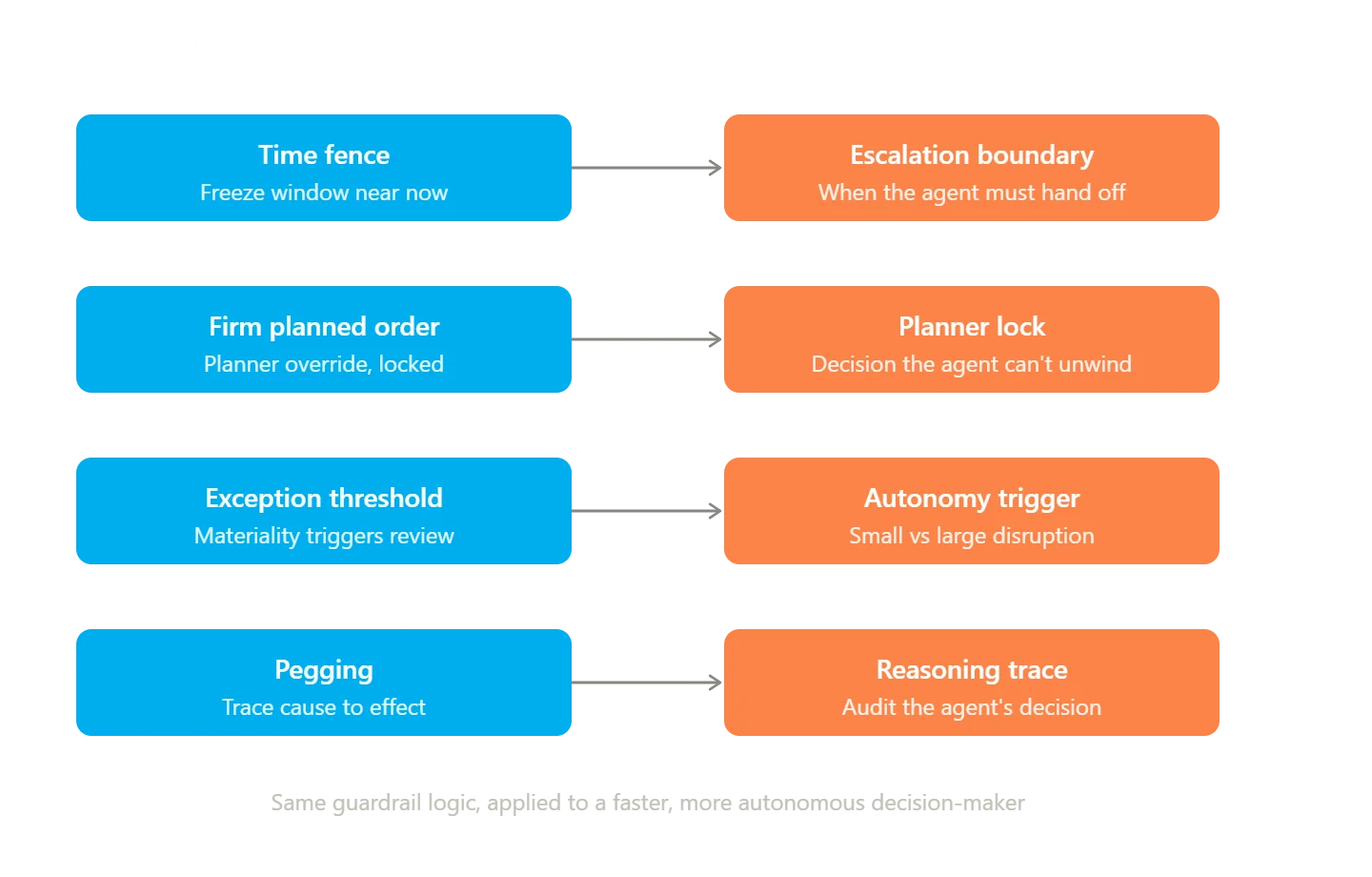
- Time fences: zones close to “now” where the plan is frozen regardless of new information, because the cost of disruption exceeds the value of the update.
- Firm planned orders: a planner's explicit override that says “don't touch this, no matter what the algorithm recommends next.”
- Exception-based management: the system only surfaces a change when it crosses a materiality threshold, instead of re-litigating every order every cycle.
- Pegging and where-used visibility: so a human can trace why the system wants to change something before approving it.
None of these guardrails made the planning logic less capable. They made it trustworthy enough to actually run a business on.
The same problem, with higher stakes
Agentic AI doesn't eliminate nervousness, rather it raises the speed and blast radius of it. A classical MRP system regenerates a plan nightly or weekly and waits for a planner to review it. An agent monitoring live signals can, in principle, re-plan continuously and act immediately. Analysts describe this as the central design question of 2026: not whether agents can detect a disruption and propose a fix, but where the boundary sits between “act autonomously” and “escalate to a human.”
That boundary is a time fence. It's the same concept your MRP system has used for forty years, just applied to a faster, more autonomous decision-maker. The organizations getting agentic AI right this year aren't the ones giving agents unlimited authority; they're the ones translating time fences, firm planned orders, and exception thresholds into explicit rules for when an agent can act alone versus when it has to hand off to a planner.
Planning in 2026 and beyond
If you're evaluating agentic capability in your demand or supply planning stack, the classic MPC questions are still the right ones to ask but they're just aimed at a new kind of decision-maker:
- Where's the time fence for this agent? Inside what window is a change frozen or escalated, regardless of what the model recommends?
- What's the equivalent of a firm planned order? Can a planner lock a decision the agent isn't allowed to unwind on its own?
- What threshold triggers escalation vs. autonomous action? A 2% forecast revision and a supplier outage shouldn't get the same response.
- Can you peg the decision? If an agent re-sequences a production run or reallocates inventory, can a planner trace the chain of reasoning back to the triggering signal in under a minute?
- Who owns the exception log? Autonomous action without an audit trail just moves nervousness from the shop floor into a black box.
Agentic AI is a genuine step forward in decision velocity by reacting to disruption signals in near real time instead of waiting for the next planning cycle. However, velocity without the governance discipline MPC already built is just faster nervousness. The planning teams who get the most value out of agentic tools in 2026 will be the ones who treat time fences, exception management, and pegging not as legacy MRP concepts to retire, but as the operating manual for how much autonomy to grant.