Ask a demand planner how they spent last Monday morning and you'll rarely hear "improving the forecast." You're more likely to hear something like this: worked through a long queue of exceptions, chased three suppliers for PO confirmations, placed an order for a SKU that slipped below its reorder point over the weekend, and squeezed in maybe forty minutes of real analysis before the S&OP pre-meeting.
Most of the AI conversation in supply chain planning has centered on the forecast, and for good reason. Machine learning models that choose and weight the right method for each item, pull in outside drivers like temperature and outlet counts, and adapt when demand shifts are a real step forward. We covered that ground in What "AI-Powered" Actually Means in Demand Planning. But a better forecast doesn't touch most of that Monday morning. The forecast is an input. The work is everything that happens after it.
That's where agentic AI comes in.
From advisor to actor
Traditional AI in planning is advisory. It crunches the data, produces a forecast or a recommendation, and hands it to a planner who decides what to do with it. The model advises and the planner acts.
An agentic system closes that loop. It watches the data (demand signals, inventory positions, supplier confirmations), works out what should happen next against the objectives and constraints you've set, and then does it. It cuts the purchase order, adjusts the parameter, or kicks off the workflow without anyone clicking "approve" on each step.
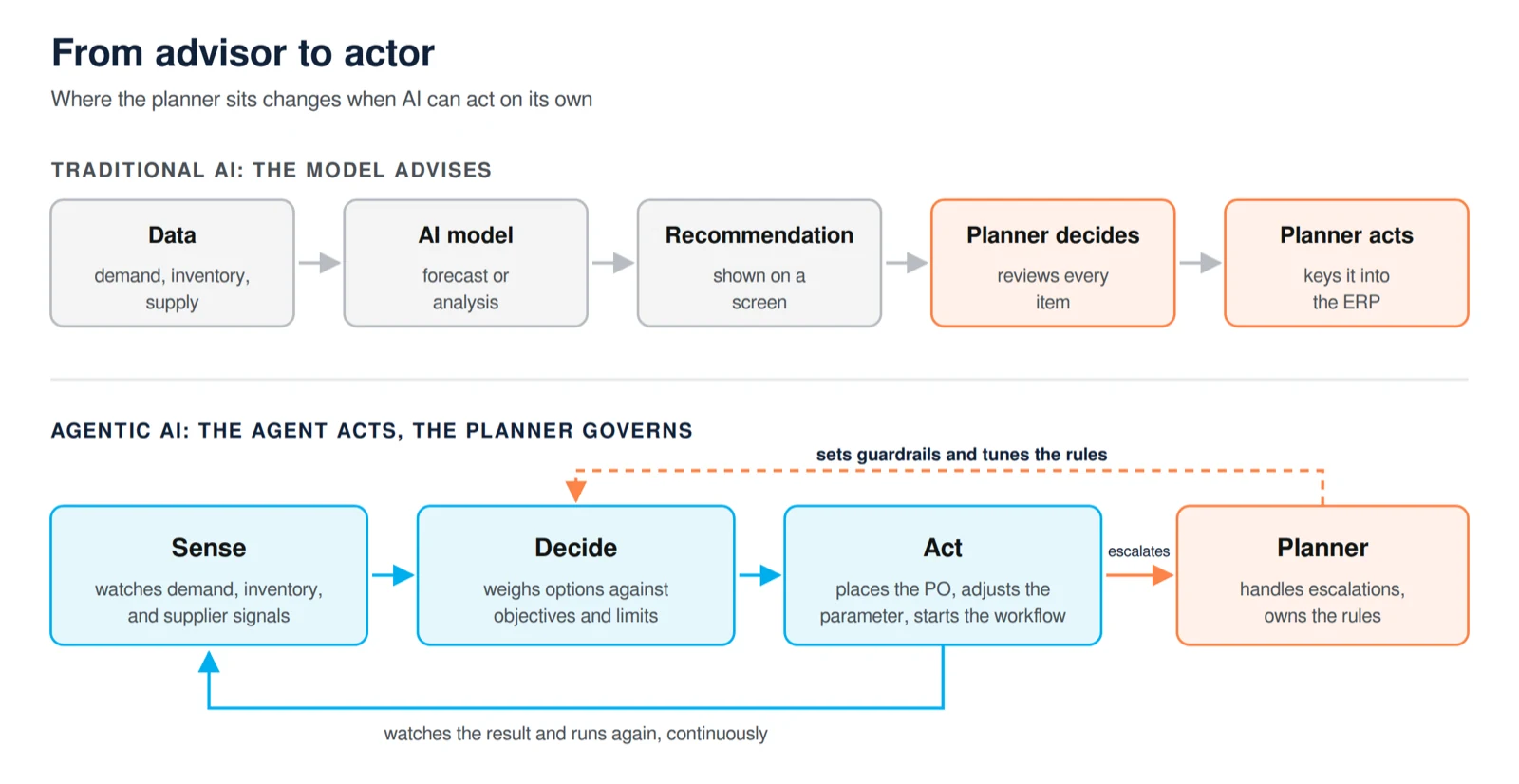
Figure 1. In the advisory model the planner does the acting. In the agentic model the agent acts and the planner governs.
How much it's allowed to do on its own is a design choice, and it's the most important one you'll make. In Agentic AI Has a Nervousness Problem, the argument was that the time fences, firm planned orders, and exception thresholds MPC has relied on for forty years are the right blueprint for governing agents. This piece picks up the other half of the question. Once the guardrails are in place, what does the agent actually do all day, and what does that leave for your planners?
Five jobs agents are already taking on
Replenishment that places itself
When inventory drops below a reorder point that reflects current demand trajectory, supplier lead time variability, and seasonality, the agent generates the purchase order or production request, routes it for approval if it's over a dollar threshold, and updates the plan to show the new supply. For fast-moving, well-understood SKUs with dependable suppliers, this is already happening. The planner stops processing routine replenishment and starts tuning the rules that drive it.
Exception triage
Planning systems throw off exceptions constantly: demand running off forecast, late POs, inventory breaching safety stock. A lot of them resolve on their own or only need a standard response, but a planner still has to open every one to find out which is which. An agent can take the first pass, apply the standard fix to routine cases, and escalate only the ones that need judgment.
Time savings are the obvious benefit. The less obvious one is speed. Routine exceptions get handled the day they show up instead of sitting in the queue until Thursday.
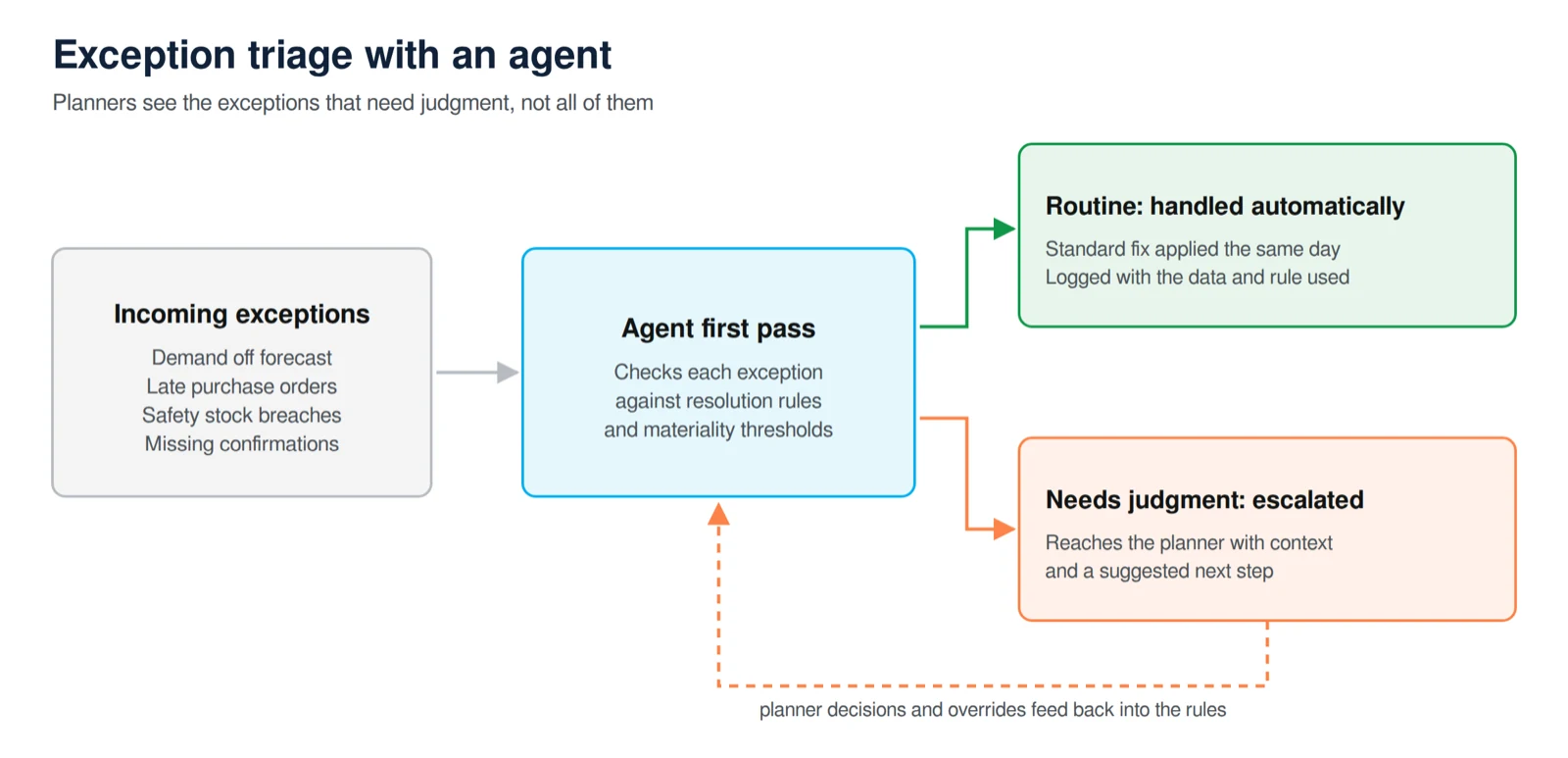
Figure 2. The agent clears routine exceptions and escalates the rest, and planner decisions sharpen the rules over time.
Safety stock that keeps up
Safety stock calculated once a quarter is stale by week three. Demand patterns shift, a supplier's on-time performance slips, a SKU gets more predictable after a model improvement. An agent watching those inputs can adjust targets as they move, adding coverage when a supplier starts missing dates and pulling it back when demand settles down.
This connects directly to Tariffs, Trade Volatility, and Supply Chain Resilience, where we recommended stratifying safety stock by tariff exposure and reviewing the high-risk tier monthly. An agent that watches policy risk indicators alongside operational data can start repositioning stock for exposed sourcing categories before an announcement lands, not after the manual review catches up. Given how many times the tariff rules have changed this year, that's a practical advantage, not a theoretical one.
Reacting to a promotion while it's still running
Promotions are one of the hardest planning problems in beverage and CPG. They create short, sharp demand spikes that need supply committed weeks ahead, based on an educated guess about lift.
Picture a sports drink feature at a regional grocer that happens to line up with the first heat wave of the summer. By day two, point-of-sale data and retailer orders show it running well ahead of plan. An agent monitoring those signals can catch the gap early and respond by expediting a production run, rebalancing inventory between DCs, or releasing safety stock to cover it. In a manual process, that same signal often isn't acted on until the weekly review, and by then the shelves are empty.
Chasing suppliers
More advanced deployments are starting to reach past the four walls. Agents can watch supplier portals for order acknowledgments and ship confirmations, send follow-ups when a response is missing, and pull in a buyer when the reply suggests a fulfillment risk. This one is still maturing, but it's an obvious target. Very few buyers got into purchasing because they love sending "just checking in" emails.
What's left for the planner
The fair question is what all of this means for the people doing the work today. The work changes a lot, and so do the skills that matter most.
Routine transactions like placing replenishment orders, clearing standard exceptions, and adjusting parameters by known rules become largely automated. The time that frees up goes to work that's been getting squeezed for years: digging into persistent forecast bias, building supplier relationships, running meaningful scenarios for S&OP, and making the calls that depend on knowing the business. No agent should be deciding whether to protect service on a key account at the expense of margin during a supply shortage. That stays a planner's call.
In an agentic environment, three skills separate the planners who thrive:
- Data literacy. Understanding what the agent is doing and why, and noticing when its output doesn't pass the smell test.
- Exception judgment. Bringing business context and relationships to the cases the agent escalates. If the guardrails are set well, those will be the hard ones.
- Rule ownership. Treating the agent's thresholds, parameters, and models as something the planning team owns and improves, rather than a black box someone configured once.
The planner's job moves up a level, from executing the plan to shaping the system that executes it.
Questions to ask before you turn it on
The Nervousness piece covered governance: time fences, locking decisions, escalation thresholds, pegging, and audit trails. If you haven't read it, start there. Beyond governance, a handful of practical questions decide whether an agentic capability actually pays off.
- Does it close the loop? If the agent's "action" is a recommendation someone re-keys into the ERP, WMS, or supplier portal, you've bought a faster advisor rather than an agent.
- Can it explain itself in plain language? A planner should be able to see what the agent did, when, and based on which data and which rule, without opening a ticket.
- How easy is an override, and what happens after? Overrides are feedback. A good system makes them quick and uses the pattern of overrides to flag rules that need a second look.
- Is your data ready? An agent working from stale lead times or bad on-hand counts makes bad decisions faster. Clean master data comes before autonomy.
- Where will you start? The best early candidates are high-volume, low-stakes, well-understood decisions. Pick one domain, measure it, and widen the fence once the agent has earned it.
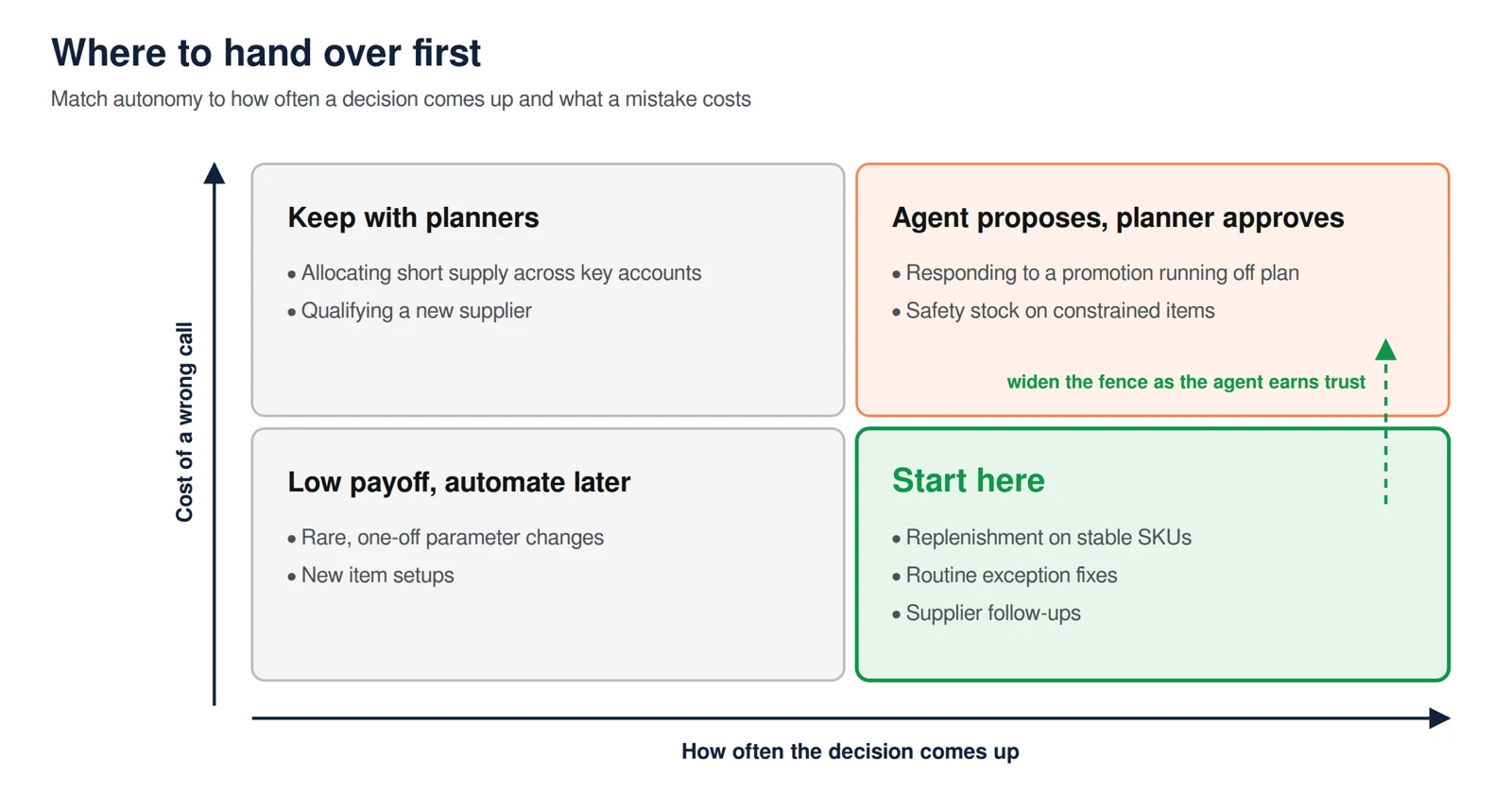
Figure 3. Start with frequent, low-stakes decisions and widen the agent's authority as it earns trust.
Where this is heading
Agentic AI in supply chain is real, and it's still early. The strongest implementations today live in bounded areas like replenishment, exception triage, and parameter tuning, where inputs are clean and success is easy to measure. The scope will widen, and probably faster than most planning organizations are set up for.
The companies that get the most out of it won't be the ones that switch on the most autonomy first. They'll be the ones that did the unglamorous work ahead of time: cleaned up their data, taught their planners how the agents make decisions, and chose platforms that can act inside the systems where the work actually happens. When the next wave of capability arrives, they'll be ready to use it. Everyone else will still be clearing the Monday morning queue.