If you want to clear a room of supply chain executives, bring up master data governance. If you want to pack that same room, put "Agentic AI" on the invitation.
The irony is that the latter cannot survive without the former. As we transition from statistical forecasting to AI-powered planning, the conversation naturally gravitates toward automated exception triage and model competition. But deploying a sophisticated AI agent on top of poor master data doesn't just limit your ROI. It amplifies your inefficiencies at machine speed.
Before you let an AI agent autonomously shape your demand baseline or re-plan your production schedule, you have to ensure the ground truth it relies on is actually true.
The Garbage-In Multiplier
In traditional MRP environments, human planners act as a buffer against bad data. A seasoned supply planner knows that a supplier's stated lead time of 14 days is actually 21 days in the winter. A demand planner knows a sudden spike in sales wasn't organic demand, but a one-off promotion that was miscoded in the system. They use tribal knowledge to mentally override the system's flaws.
Agentic AI lacks this tribal knowledge. When an AI model takes over, it treats your ERP's master data as absolute gospel.
This dynamic creates a dangerous illusion. If you look at how AI performs across different states of data hygiene, a startling reality emerges: AI actually performs worse than legacy systems when your data is poor.
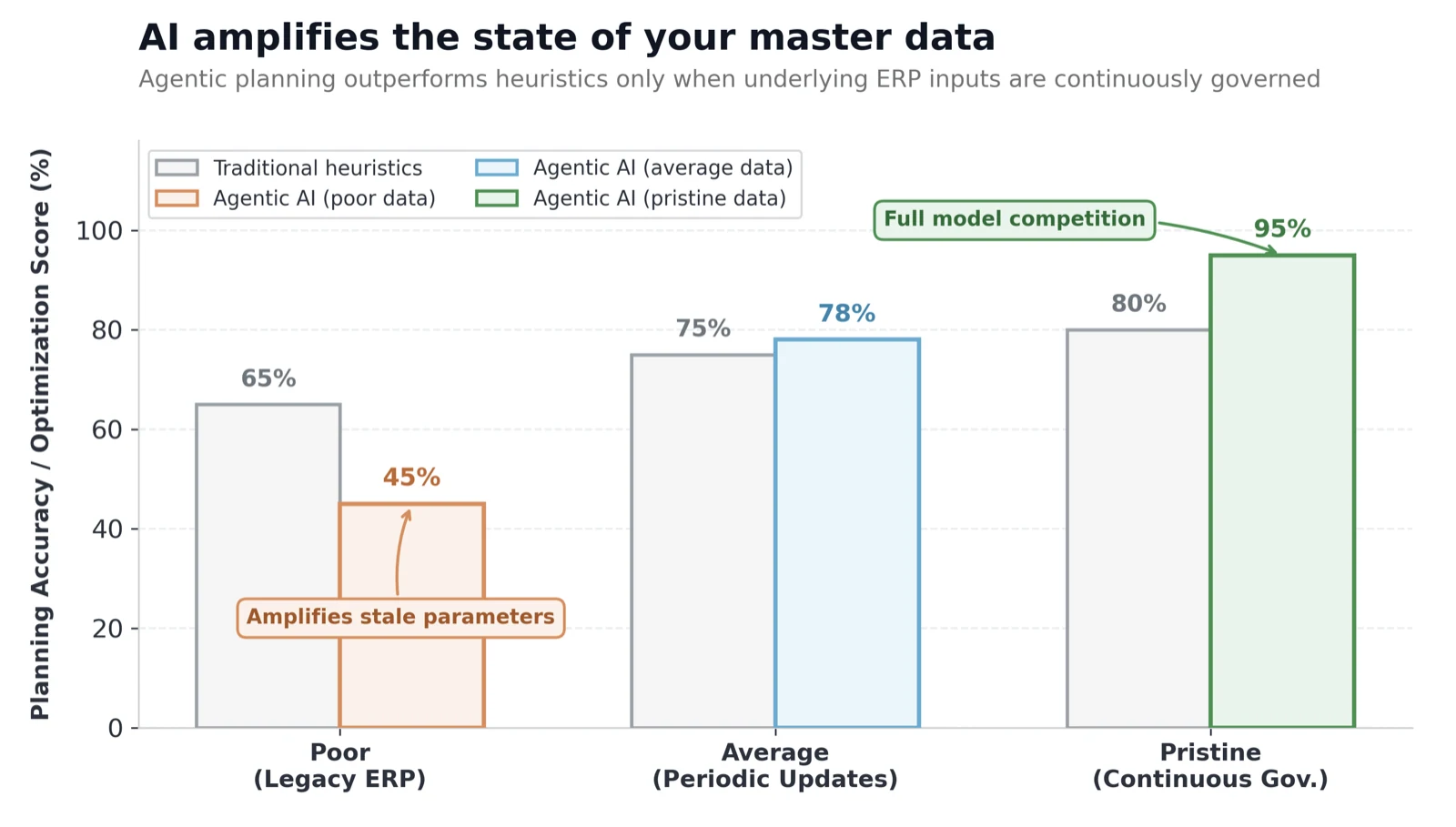
Why does the orange bar on the left drop well below traditional heuristics? Because legacy rules are usually buffered by human skepticism. AI, on the other hand, aggressively optimizes based on the math you feed it. If you feed it bad math, it confidently executes a series of terrible decisions.
Where AI Breaks in Demand Planning
Neural networks thrive on recognizing patterns across product families and market variables. But to leverage a platform like Forge DP to its fullest potential, your foundational data must be structured for machine learning, not just accounting.
- Item Hierarchies & Naming Conventions: If your item master is a messy, unstructured list, AI cannot effectively learn from similar products. When a new SKU launches, the AI relies on historical data from its predecessors to generate a baseline. If the hierarchy is broken, the model is flying blind.
- Substitution Logic: Smart demand planning requires knowing what happens during a stockout. Did the customer buy a competitor's product, or did they buy a different pack-size of your product? Without clean substitution master data, the AI interprets a stockout as zero demand, actively forecasting a drop in future sales right when you actually need to replenish.
The Supply Planning Bullwhip
The risks multiply when we move from forecasting demand to actually buying and moving inventory. In supply planning, bad master data directly ties up working capital.
Consider what happens when you turn an optimization engine loose on outdated lead times or incorrect Minimum Order Quantities (MOQs).
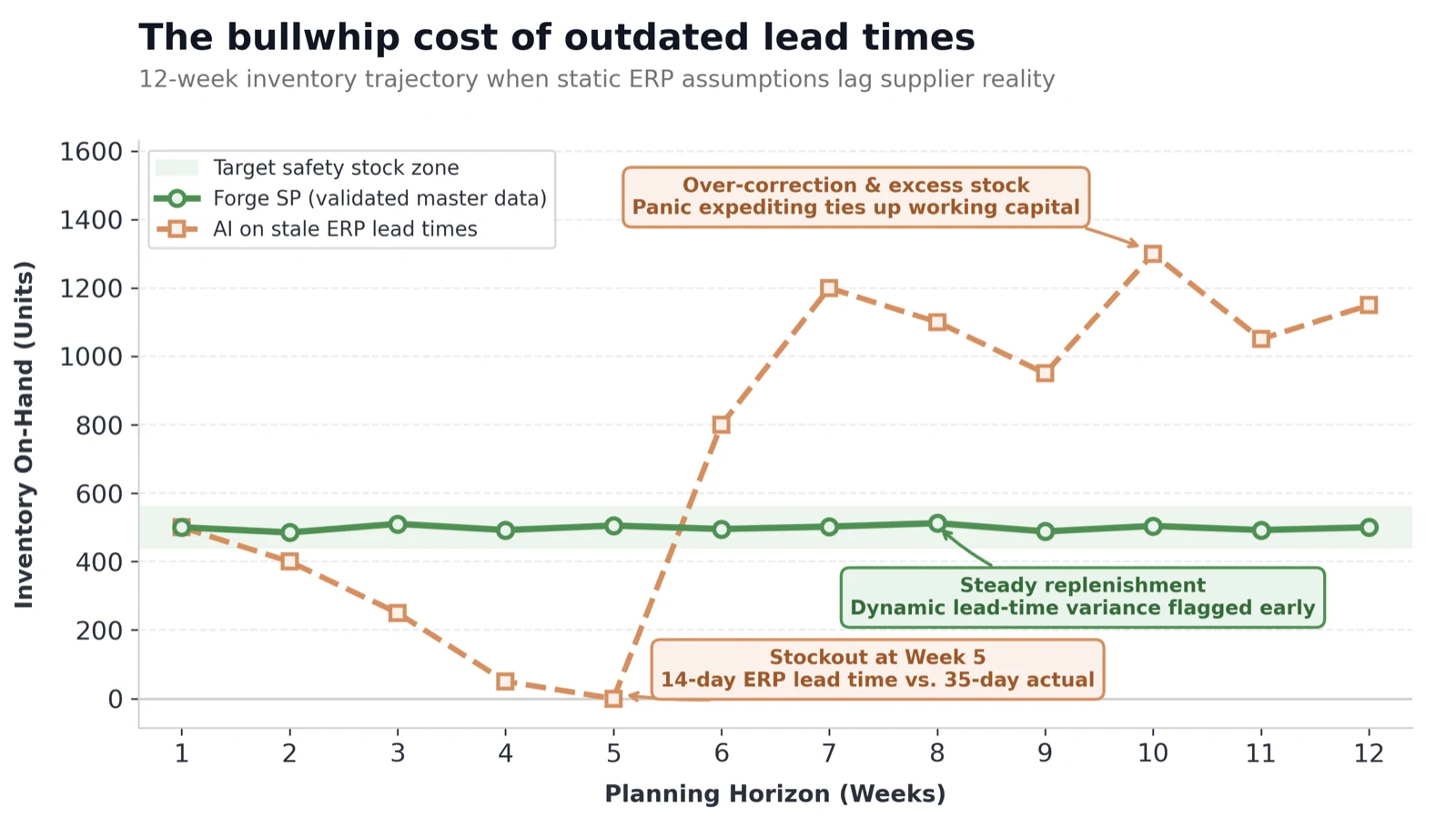
If a raw material's lead time in the ERP is listed as 14 days, but the reality at the port is 35 days, a platform like Forge SP, if not configured to flag this discrepancy, will wait to order based on the 14-day assumption. The result? A massive stockout (the dashed orange line cratering to zero at Week 5), followed by panic-ordering, expediting fees, and ultimately an over-correction that leaves you drowning in excess inventory weeks later.
Static lead times and static MOQs are relics of the past. Your data must reflect carrier performance, seasonal delays, and supplier realities so the AI can calculate an accurate, probabilistic safety stock.
Elevating the Data Steward
To achieve the "Monday Morning" we often talk about at Areté, where routine replenishment is automated and human talent is reserved for strategic triage, organizations must elevate the role of the data steward. Data hygiene can no longer be an annual IT cleanup project. It has to be a continuous operational discipline.
This is why we built Forge DP and Forge SP not just to consume data, but to challenge it. Our platforms are designed to flag the anomalies, highlighting where the system's lead times deviate from actual receipt dates, or where demand histories look suspiciously artificial, so planners can fix the root cause before the algorithm runs.
AI doesn't replace the need for rigorous process discipline; it demands it. By cleaning house now, you ensure that when you flip the switch on advanced model competition, your algorithms are fighting market volatility, not your own internal data errors.