
Where Neural Networks Earn Their Keep in Demand Planning
When neural networks improve demand forecasts, how to train them on short weekly histories, and why every model should compete against simpler ones before it ships.
October 17, 2026Read More »
In today’s competitive business environment, supplier performance is critical to maintaining product quality, ensuring timely delivery, and achieving customer satisfaction for the value chain. Measuring supplier performance effectively requires a combination of well-defined metrics, clear communication, and actionable improvement plans. In this blog, we’ll explore how to measure supplier performance using key metrics, and then outline an action plan to ensure continuous improvement.
Quality is one of the most critical aspects of supplier performance. A common metric for measuring quality is:
Quality Performance = (Quantity Received - Quantity Rejected) / Quantity Received * 100
This formula calculates the percentage of materials or products that meet your quality standards. For example, if you receive 1,000 units and reject 50 due to defects, the quality performance would be:
(1,000 - 50) / 1,000 * 100 = 95%
Action Plan for Quality Performance:
Delivery performance measures the supplier’s ability to meet agreed-upon timelines. The metric is:
Delivery Performance = (Number of Purchase Orders Received On Time / Total Number of Purchase Orders) * 100
For example, if 90 out of 100 purchase orders are delivered on time then the delivery performance is 90%.
Action Plan for Delivery Performance:
A Supplier Scorecard is a Service Performance composite metric that evaluates multiple aspects of supplier service, including invoicing accuracy, delivery documentation, responsiveness, and certification of analysis (CoA). Here’s one way it could be calculated:
Service Performance = (Invoice Accuracy % * Wt1 + Delivery Documentation % * Wt2 + Response Time % * Wt3 + CoA Compliance % * Wt4)
where Weights (Wt1+Wt2+Wt3+Wt4) should sum to 1.
Example Calculation:
Supplier Scorecard = (95*0.25 + 90*0.25 + 85*0.25 + 100*0.25) = 92.5%
Note that on-time delivery can be added as a fifth component (with Wt5) to the scorecard to measure the percentage of deliveries made on or before the agreed-upon delivery date but since this was captured in delivery performance, it was left out here to focus on supplier’s service.
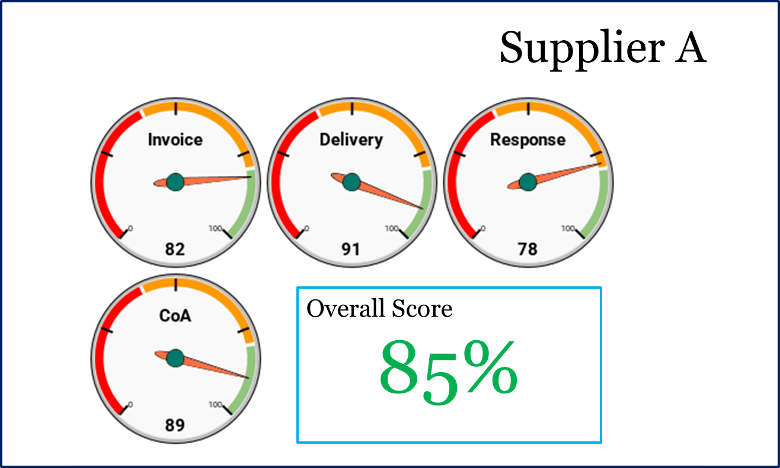
Action Plan for Service Performance:
To further enhance a supplier performance evaluation, consider utilizing these additional metrics:
To effectively measure and improve supplier performance, follow these steps:
Measuring supplier performance is essential for maintaining a competitive edge in today’s market. By focusing on key metrics like quality, delivery, and service, and implementing a structured action plan, you can build stronger supplier relationships, drive continuous improvement, and ensure your supply chain operates at peak efficiency. Don’t forget to explore additional metrics like cost performance, flexibility, and sustainability to create a holistic view of supplier performance. With the right approach, you can turn supplier management into a strategic advantage for your business.

JR has 2 decades of experience in Demand and Supply Planning helping customers achieve desired results.
February 21, 2025
Category: Supply Chain Management
When neural networks improve demand forecasts, how to train them on short weekly histories, and why every model should compete against simpler ones before it ships.

A better forecast doesn't touch most of a planner's Monday morning. Agentic AI goes after the work that follows it: replenishment, exception triage, safety stock, promotion response, and supplier follow-up. What agents take on, what stays with the planner, and the questions to ask before you turn one on.

A single temperature excursion can make a whole truckload unsaleable, and cold chain failures often stay invisible until a return or an inspection. The five metrics that form a cold chain measurement program, the targets to hold them to, and the management practices behind them: carrier qualification, FEFO rotation, temperature mapping, and incident response.