
Where Neural Networks Earn Their Keep in Demand Planning
When neural networks improve demand forecasts, how to train them on short weekly histories, and why every model should compete against simpler ones before it ships.
October 17, 2026Read More »
In our previous blog, Optimizing Beverage Production Lines: Exploring Sistering and Cousining, we reviewed two innovative methods for improving production scheduling efficiency, and here we'll unpack critical planning horizons that drive success in the beverage industry.
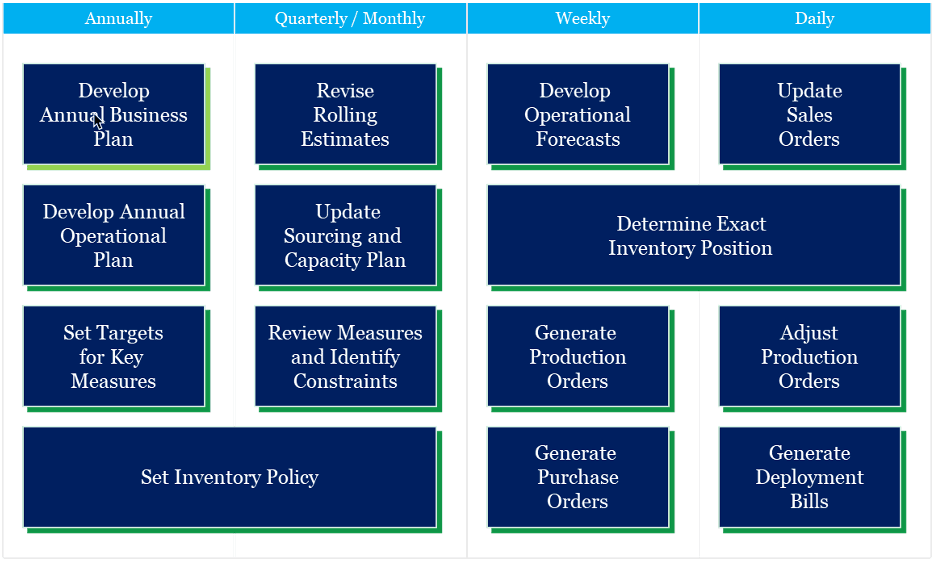
Supply chain planning isn't a one-size-fits-all approach; rather it's a nuanced process divided into three distinct yet interconnected horizons:
While these horizons often overlap, understanding their unique characteristics is crucial for effective supply chain management.
Frequency: Annually
Horizon: 18 Months to 5 Years
Strategic planning is the compass that guides an organization's long-term vision. It is comprised of:
The ultimate goal of strategic planning is to define the company's long-term vision, develop infrastructure, and identify strategic advantages that can be leveraged to gain market share and improve profitability.
Frequency: Quarterly or Monthly
Horizon: Often up to 18 months
Tactical planning transforms high-level strategic goals into actionable blueprints:
Frequency: Weekly to Daily
Horizon: Often up to 13 weeks
Operational planning is where strategy meets day-to-day execution:
The key to effective operational planning is maintaining a delicate balance between flexibility and stability. While it's tempting to lock down schedules, true efficiency comes from:
The broader objective is to design processes that:
Supply chain planning in the beverage industry is a complex dance of strategic vision, tactical adaptation, and operational precision. By understanding and effectively managing these three planning horizons, organizations can create a robust, responsive Supply Chain that drives competitive advantage. Areté’s Demand Planning and Supply Planning solutions are built for purpose and allow organizations to react more nimbly (and cost-effectively) to the dynamic markets they serve.
In our next blog, Mastering Costing Measures: A Beverage Industry Insider's Guide, we'll explore key costing measures that complement these planning strategies. Stay tuned by subscribing to our blog!

JR has 2 decades of experience in Demand and Supply Planning helping customers achieve desired results.
December 12, 2024
Category: Strategy and Best Practices
When neural networks improve demand forecasts, how to train them on short weekly histories, and why every model should compete against simpler ones before it ships.

A better forecast doesn't touch most of a planner's Monday morning. Agentic AI goes after the work that follows it: replenishment, exception triage, safety stock, promotion response, and supplier follow-up. What agents take on, what stays with the planner, and the questions to ask before you turn one on.

A single temperature excursion can make a whole truckload unsaleable, and cold chain failures often stay invisible until a return or an inspection. The five metrics that form a cold chain measurement program, the targets to hold them to, and the management practices behind them: carrier qualification, FEFO rotation, temperature mapping, and incident response.