Current as of late August 2026. Trade policy is still moving quickly, and specific rates and authorities cited here may change.
If you'd told a supply chain planner in early 2025 that the legal basis for the country's tariff regime would be rebuilt three separate times before the year was out, they'd have assumed you meant three years, not three quarters. Tariff policies have shifted dramatically, the legal authorities behind them have shifted just as much, ocean freight lanes are being redrawn, and the assumptions that used to anchor a supply chain plan, stable sourcing relationships, predictable lead times, cost structures you could actually forecast against, don't hold the way they used to.
For beverage and consumer packaged goods (CPG) companies, that's a real problem, not an abstract one. Margins are already thin. Ingredients, packaging materials, and finished goods cross borders multiple times before they ever reach a shelf. And demand planning cycles run long enough that a sourcing decision made this month is really a bet on service levels six to twelve months out.
We've spent more than four decades at Areté helping beverage and CPG manufacturers plan through disruption. Weather events, supplier failures, demand shocks. This year has just added a new one to the list. Below is what we're seeing across our client base, what's actually working, and where a planning platform earns its keep versus where it's just another dashboard.
Understanding the Current Tariff Environment
The tariff actions that began in 2025 didn't just continue into this year. They got torn down and rebuilt, and that rebuild is really the whole story of 2026 so far.
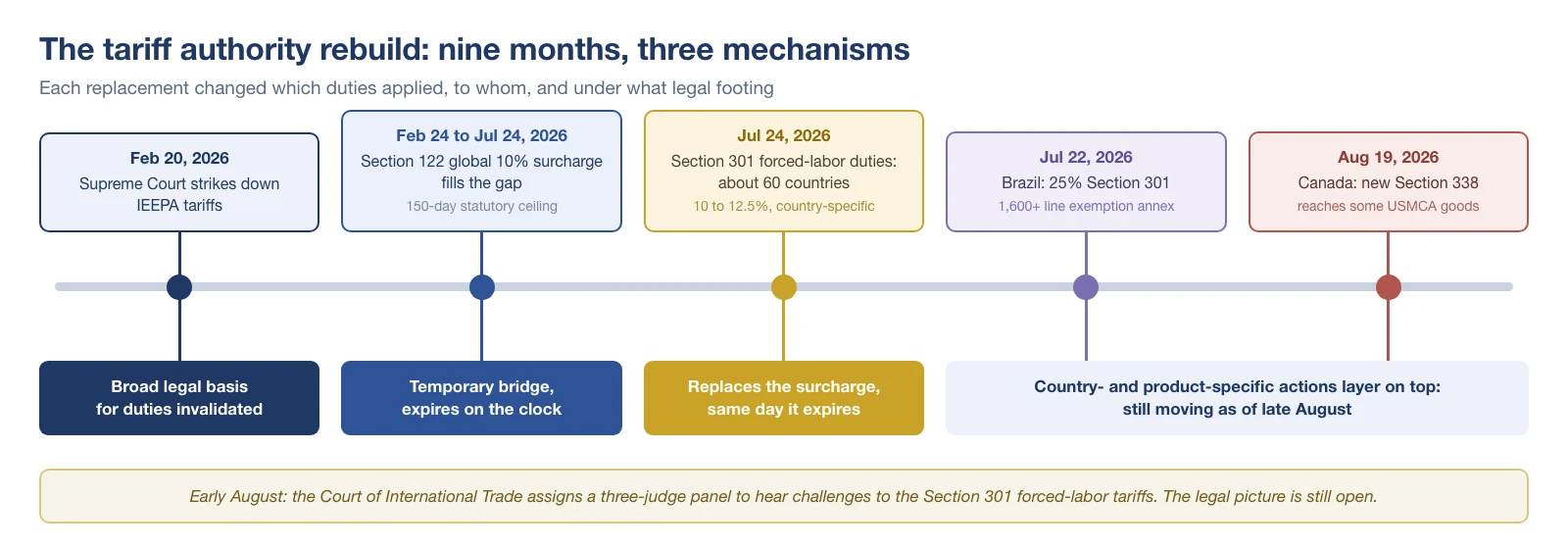
In February, the Supreme Court ruled that the International Emergency Economic Powers Act doesn't authorize the president to impose tariffs at all, which knocked out the legal basis for a large share of the duties companies had spent a year planning around. A temporary global import surcharge under Section 122 of the Trade Act of 1974 filled the gap almost immediately, but that authority came with a hard 150-day statutory ceiling, and it expired on July 24.
What replaced it, on the very same day, was a new Section 301 action tied to forced-labor enforcement, hitting roughly 60 trading partners at 10 to 12.5 percent. A separate 25 percent Section 301 duty on most Brazilian goods got finalized in late July, though with a fairly generous exemption annex: over 1,600 tariff lines, including coffee, beef, and pharmaceuticals. Then, on August 19, a new Section 338 tariff landed on a wide range of Canadian goods, and this one is worth flagging specifically: it applies even to some products that would otherwise clear duty-free under USMCA. Section 232 rates on aluminum, steel, and copper keep getting adjusted on their own separate timeline, and the EU trade deal's 15 percent rate has been in effect since July 1. As of early August, the Court of International Trade has a three-judge panel assigned to hear challenges to the new Section 301 forced-labor tariffs, so none of this should be treated as final.
Two things follow from that for anyone doing the planning.
First, your exposure has changed shape even in places where the total dollar burden looks similar. Section 301 and Section 232 duties are product-specific and country-specific in a way the old blanket surcharges weren't. Two SKUs that looked identically exposed in January can look completely different today. Stacking rules matter. Exemption annexes matter. Rules of origin matter more than they used to, by a wide margin.
Second, North America isn't the stable baseline it used to be. The USMCA joint review opened July 1, and the agreement wasn't renewed in its current form. It's still in force, but on a countdown, with rules of origin and content thresholds now under extended negotiation. If your sourcing strategy treated USMCA as a fixed anchor, that anchor is now a range.
For beverage manufacturers, this shows up in aluminum and glass costs for packaging, in sweetener and flavoring costs, and in refrigeration equipment procurement. For CPG more broadly, it's resins, corrugated materials, and electronic components. A lot of organizations are still working out exactly how much that's rippled through their cost structure, because the rippling hasn't stopped long enough to measure it cleanly.
The rates themselves aren't even the hard part. It's that the mechanism generating them has changed three times in nine months. Build a procurement strategy around a specific landed-cost assumption and it can go stale within weeks of an announcement, sometimes within days of a court ruling.
Strategy One: Scenario Planning as a Core Competency
The single most important shift supply chain leaders can make in a volatile tariff environment is treating scenario planning as an ongoing discipline rather than an occasional exercise.
Traditional supply chain planning assumes a single future state: forecast demand, plan supply accordingly, and manage exceptions as they arise. Scenario planning replaces that single-path approach with a set of parallel plans built around different assumptions about how key variables (tariff rates, exchange rates, lead times, supplier availability) might evolve.
For tariff volatility specifically, useful scenarios to maintain include:
- Base Case: current rates persist with minor adjustments.
- Escalation Case: duties increase by a defined increment on primary sourcing regions, triggering a cost threshold that requires sourcing changes.
- Resolution Case: trade tensions ease, or an authority lapses or is struck down, and previously tariffed goods return to lower duty rates. This creates a window for cost recovery, and it is no longer a hypothetical.
- Disruption Case: a key supplier or sourcing region becomes unavailable due to regulatory action, requiring emergency qualification of alternates.
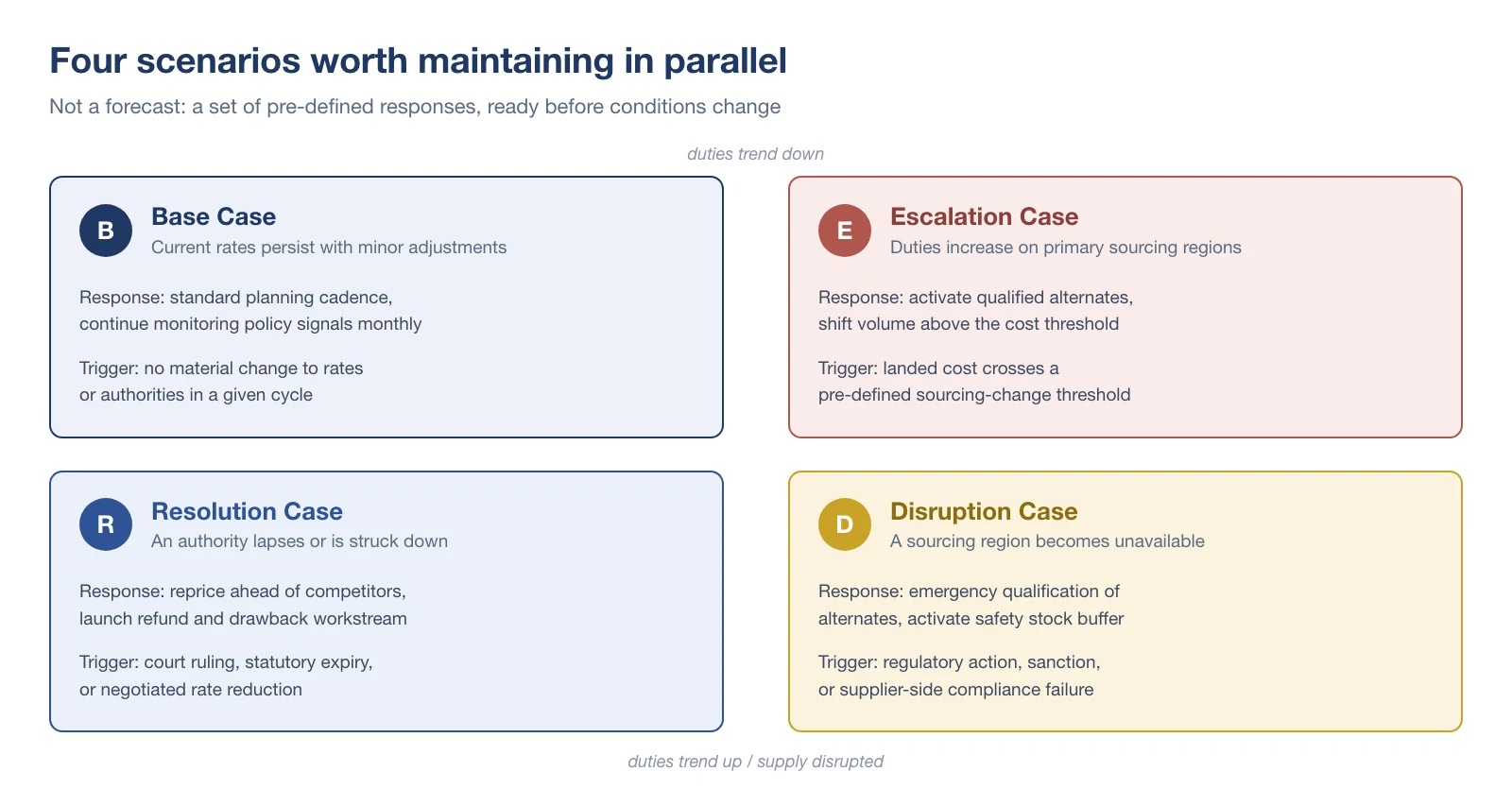
The Resolution Case deserves more attention than it usually gets, and most organizations still skip it. Tariff risk tends to get modeled as one-directional, up only. But 2026 showed duties can come off fast too, and the companies that hadn't planned for that found themselves sitting on inventory bought at an elevated landed cost while competitors quietly repriced around them. Refund and drawback processes are their own separate work stream when an authority gets struck down retroactively, and that's not a fun one to build from scratch under time pressure.
For each scenario, pre-define the actual response: which alternate suppliers get activated, what inventory positioning has to change, what the customer service risk looks like mid-transition. It's the pre-work that buys you speed later. Nobody wants to be figuring out their backup supplier's lead time on the day they need it.
Our Scenario Planning capability inside Prevail is built for exactly this: modeling tariff, freight, and lead-time scenarios against live demand and supply data, so planners can see the operational and financial trade-offs of each path before they have to commit to one.
Strategy Two: Supply Base Diversification
A supply base concentrated in one geography is a single point of failure once tariffs start moving this much. Diversification, meaning qualified alternate suppliers spread across regions, is the structural fix, and it's not a quick one.
That doesn't mean walking away from existing relationships. It means building optionality on top of them. For critical ingredients and packaging materials, aim for at least two qualified suppliers in different tariff jurisdictions. That's what actually lets you shift volume when costs move, without a scramble that tanks quality or lead times.
Qualification isn't fast. Six to twelve months is typical once you factor in quality audits, trial runs, and regulatory approvals, so this work has to start well before a crisis makes it urgent. Whoever is qualifying alternates right now is building resilience for the next disruption, not just this one.
Nearshoring still makes sense as a general direction, but the math behind it got harder. Mexico still has the proximity, the cost position, and the established supplier base, and it remains competitive against Asian sourcing on most of those dimensions. What's changed is that USMCA preference can't be treated as a permanent given anymore, and rules of origin are actively being renegotiated. The new Section 338 action on Canadian goods, which reaches even some USMCA-qualifying products, is a pointed reminder that "North American" doesn't automatically mean "duty-free" anymore.
Practically, that means nearshoring decisions need real documentation discipline behind them now, not just a general sense that things are close by. Know your origin content precisely. Know where your suppliers' own inputs come from. Stress-test the sourcing case against a scenario where preference terms tighten further. And it's worth a second look at domestic suppliers you passed over on cost a year or two ago, because the math changes once landed cost is calculated properly instead of on unit price alone.
Strategy Three: Safety Stock Recalibration
In a stable environment, you size safety stock on demand variability and supplier lead time variability, full stop. In a volatile one, there's a third variable: policy risk. The odds that a key input gets hit with a sudden cost increase or supply interruption need to show up in how you position inventory.
That doesn't mean padding everything. Carrying costs are real money, and tying up working capital isn't free either. A risk-stratified approach works better:
- Tier 1, high exposure, no real substitute: sourced from high-tariff regions with nothing qualified to fall back on. Carry elevated safety stock here and review it monthly, not quarterly.
- Tier 2, exposed but covered: there's exposure, but a qualified alternate is already in place. Standard safety stock is fine, as long as you've confirmed that alternate can actually scale up fast enough.
- Tier 3, low exposure: domestic or low-duty sourcing under stable terms. Run this lean and put the working capital elsewhere.
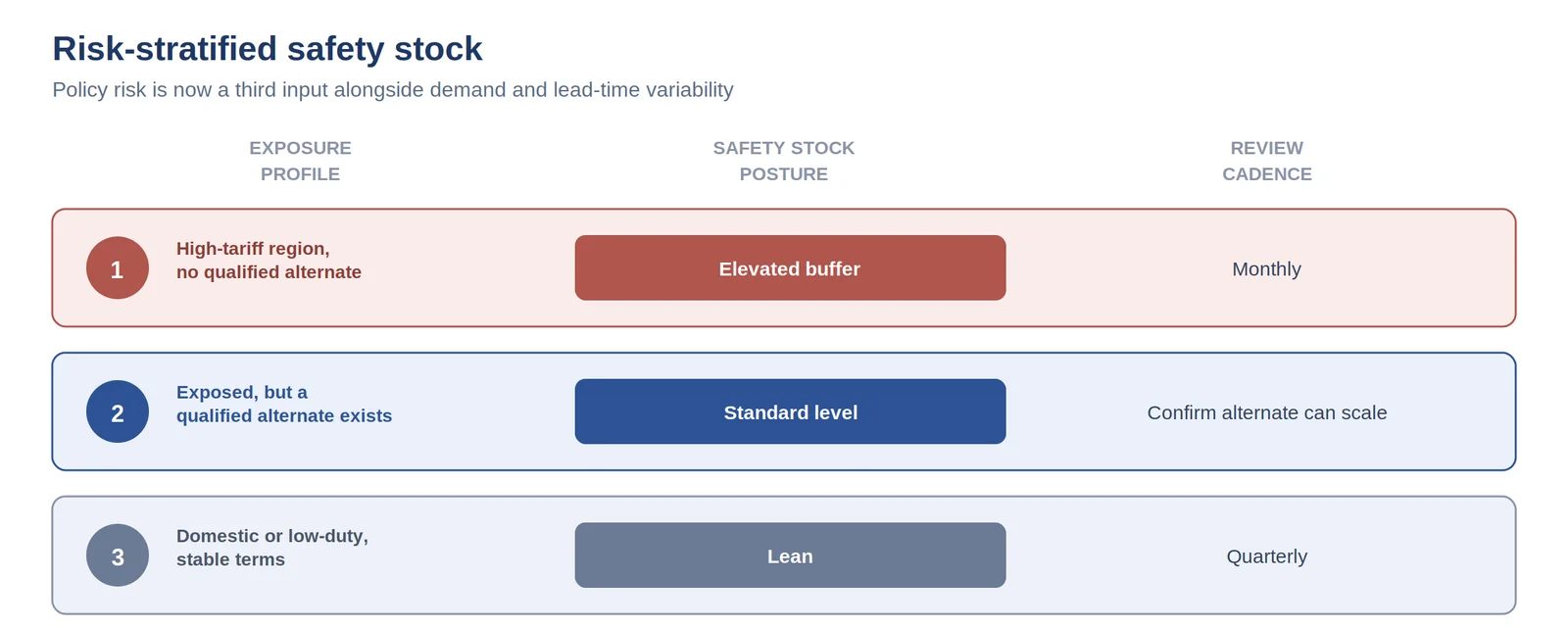
Revisit the tiers quarterly at a minimum, sooner if a policy shifts materially, and given how often that's happened this year, quarterly is really a floor, not a target. Nothing about a tier assignment should be treated as permanent. It reflects today's risk, not last year's.
This is basically what Inventory Planning and Optimization in Prevail automates: it rebalances safety stock targets as risk profiles shift, instead of everyone waiting for the next scheduled review to catch up to reality.
Strategy Four: Total Landed Cost Visibility
A lot of procurement decisions still get made on unit price alone, which is a problem, because unit price tells you almost nothing right now. Total landed cost, meaning duties, freight, insurance, currency exchange, import compliance costs, lead time carrying costs, all of it, is what should actually be driving sourcing decisions.
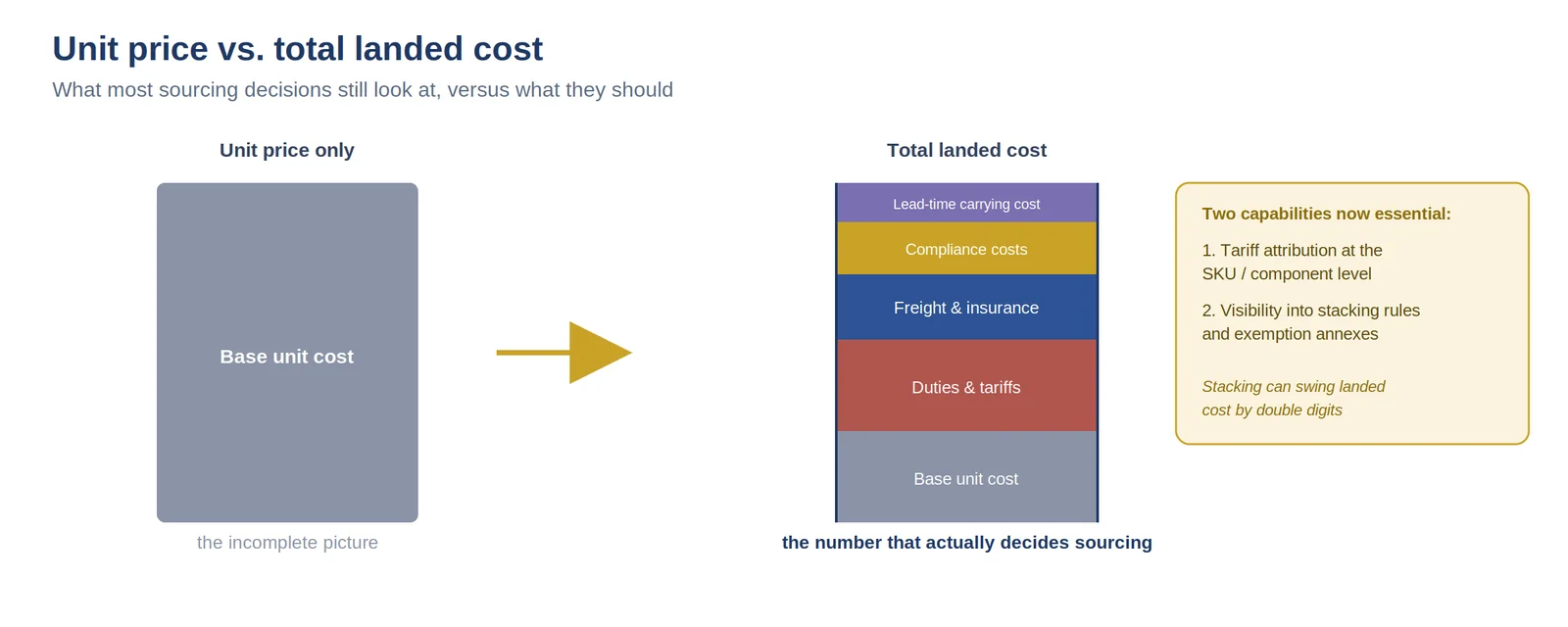
Getting there means connecting procurement, logistics, and customs data in ways most organizations were never really set up to do. It's worth the lift. Companies with real-time total landed cost visibility spot the economically justified sourcing shifts before their competitors even notice, and they can price out the impact of a new policy in hours instead of weeks.
Two things have gone from nice-to-have to non-negotiable this year. One is tariff attribution down at the SKU and component level, because product-specific and country-specific duties don't roll up cleanly the way a blanket surcharge used to. The other is visibility into stacking rules and exemption annexes, because whether two measures apply on top of each other can move landed cost by double digits, and that's not a rounding error for anyone.
This is the piece an integrated platform actually earns its place on. Our IBP, S&OE and S&OP Visibility capability pulls demand, supply, and cost data into one planning process, so a sourcing decision gets weighed on cost and service level at the same time, not in two spreadsheets that get reconciled a week later.
Strategy Five: Collaborative Planning with Key Customers and Suppliers
No single organization manages this kind of volatility alone. The companies handling it best tend to have the deepest relationships in both directions, upstream with suppliers and downstream with key customers.
Upstream, that means sharing demand forecasts early enough that suppliers can actually adjust sourcing and production, not just react. It means pricing transparency clauses that allow real cost pass-through when duties genuinely raise input costs, and increasingly, clauses that work the other way too when duties come off. And it means doing scenario planning jointly, so both sides know the playbook before conditions change instead of after.
Downstream, it's proactive communication about lead times, price moves, and service risk before any of it shows up as a missed order. Customers who hear it coming can adjust their own plans. Customers who get surprised go find someone else.
S&OP is the natural home for this kind of coordination, and organizations with a mature S&OP cadence, where supply constraints are visible to commercial teams and demand signals move quickly back to supply planners, are simply better positioned than the ones running these functions in silos. Our Collaborative and Long-Term Planning capability is built to carry that coordination outside the four walls of one organization, out to the suppliers and customers who actually need to see it.
What Good Planning Infrastructure Looks Like
A lot of this comes down to information management as much as supply chain strategy. The organizations moving fastest have real-time visibility into cost exposure, the ability to model scenarios, and a short path from policy change to operational decision.
A few capabilities worth prioritizing:
- Integrated demand and supply planning, so cost changes flow straight into sourcing and production decisions.
- Scenario planning that handles multiple policy assumptions at once, including the ones where duties go down.
- Total landed cost modeling built into procurement and planning, granular enough for product-specific and country-specific duties.
- Multi-echelon inventory optimization that rebalances safety stock as risk profiles change.
- Collaborative planning portals that extend visibility out to suppliers and customers.
This is more or less the list we built Prevail around, and it's why we spend as much time as we do actually configuring it with clients instead of shipping a template and moving on.
Conclusion
Trade volatility isn't a storm to wait out. It's a structural feature of the environment now, and it needs to be planned around indefinitely. This year made that case better than any argument could: the rates changed, then the legal machinery producing the rates changed, then it changed again. Companies whose planning assumed one stable policy path spent 2026 reacting to the news.
The organizations that come out ahead won't be the ones that react fastest to an announcement. They'll be the ones that already built the diversified supply base, the scenario planning habit, the safety stock framework, and the planning infrastructure to move before the pressure hits.
That work pays off well past tariffs, honestly, because the same capabilities that protect against policy risk protect against weather, supplier failure, and demand shocks too. Resilience built on purpose tends to hold up longer than resilience built in a hurry.
Areté has been doing this with beverage and CPG companies in more than 45 countries since 1984. If your team is rethinking its planning infrastructure for this environment, we'd like to hear about it.
Request a Demo | Contact Our Sales Team